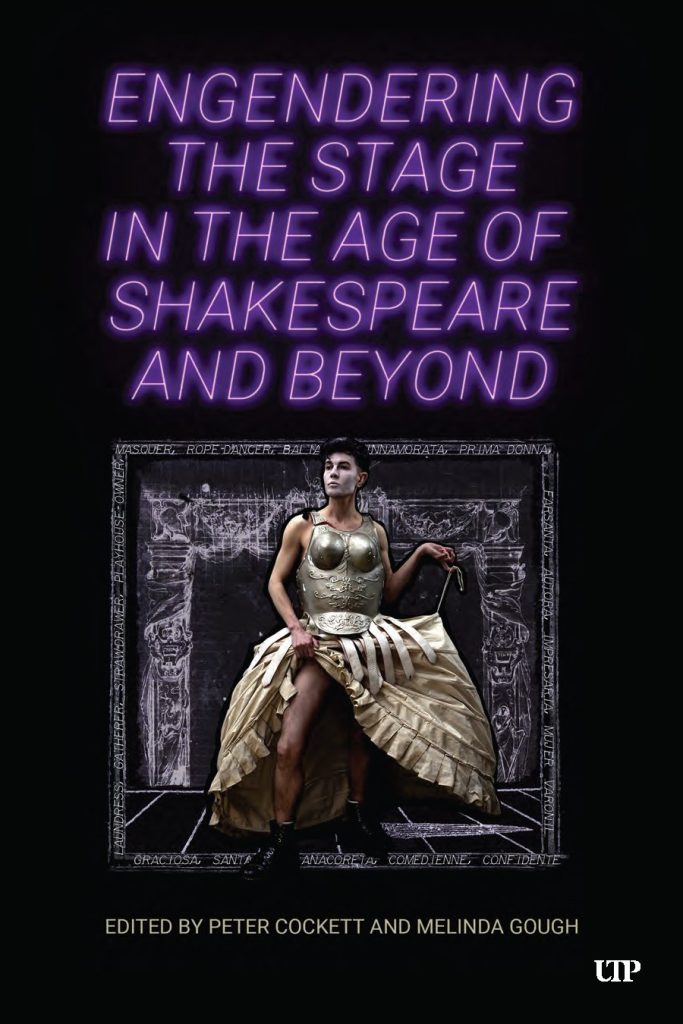
Engendering the Stage in the Age of Shakespeare and Beyond steps beyond the myth of the all-male stage, centring feminist, queer, and trans scholars and artists to reveal the deeper complexities of gendered performance on stage today and within the records of theatre history.
Engendering the Stage in the Age of Shakespeare and Beyond centres dialogue between scholars, students, and professional theatre practitioners to rethink gender on the early modern stage and its resonance for casting, staging, and design in contemporary classical theatre. Its scope extends beyond the confines of Shakespeare’s Globe and the myth of the all-male stage to explore the exciting possibilities of gendered performance evident on the stages of Europe and in the work of less-famous playwrights.
Women and queer and trans artists and artisans were central to the theatres of early modern Europe, and this book’s collaborative exploration of this historical evidence opens exciting new avenues for theatrical production and research. It mobilizes shared insights by scholars and theatre practitioners who hold deep investments in gender equity in their respective workplaces and explores Two-Spirit and trans histories typically excluded in both theatre history studies and present-day performance repertoires.
Engendering the Stage in the Age of Shakespeare and Beyond offers provocations arising from a five-day Performance as Research (PaR) workshop at the Stratford Festival. Featuring guest artist and actor commentary, a poem, a zine, scholarly essays and reflections, and three specially commissioned visual art pieces, the book adapts to print form the open and exploratory spirit of the workshop itself, inviting readers to embrace the possibilities of trans-disciplinary, provisional knowledges and knowledge dissemination that are central to PaR methodologies.
“This book is an energizing and pathbreaking collection in so many ways. It’s an incredibly generous, open example of how to combine cutting-edge scholarship in early modern studies with ethical practice: how to be reflective and reflexive in trans-inclusive work, how to set a collection of essays in genuine conversation with one another, and how to do decolonial early modern scholarship that isn’t just ‘writing about racism.’ I’m so enthused by having read it, and I know scholars and students alike will be too – it’s an essential addition to any classroom working with early modern texts or with dramatic texts more broadly.” Kit Heyam, Award-Nominated Writer, Historian, Heritage Practitioner, and Educator
“Engendering the Stage in the Age of Shakespeare and Beyond is a powerful, deeply thoughtful, care-filled volume that will become a must-read for anyone interested in Performance as Research, early modern or otherwise. Cockett and Gough are unflinchingly honest about the complexities of the PaR process, and the book’s most urgent contribution to knowledge is its ability to face that complexity head-on. This volume lovingly examines what worlds we can make together when artists and scholars are willing to trust one another, be real with one another, fight fairly with one another, and build learning communities together. A glorious read.” Kim Solga, Professor of Theatre Studies, Western University
“Engendering the Stage in the Age of Shakespeare and Beyond is a transformative collection of essays, interviews, and artwork. Its contributors challenge the methods of early modern PaR and demand a more ethical, inclusive, and accountable scholarship. The rewards of such rigour are considerable: the work contained in this volume demolishes the myth of the all-male early modern stage with panache.” Will Tosh, Director of Education (Higher Education and Research), Shakespeare’s Globe
“This collection is essential reading for anyone invested in troubling dominant narratives of the early modern stage, especially where gender is concerned. The authors write with passion, vulnerability, and deep insight, acknowledging mistakes and misunderstandings, while offering practical advice for artists, educators, and researchers seeking a more equitable future. A model for future PaR scholarship.” Marlis Schweitzer, Professor, Department of Theatre, Dance, and Performance, York University, and Co-producer/Co-creator of the Shaking Up Shakespeare Podcast
Before Charlie Josephine’s I, Joan even opened at Shakespeare’s Globe this summer, it provoked reactions from critics and commentators for its presentation of Joan of Arc as non-binary. Despite the historical record of Joan’s gender identity being inconclusive at best, many were surprised and challenged by the invitation to consider Joan as ‘they’ – as someone whose identity corresponded to neither male nor female, and whose dress and appearance shifted across the gender spectrum in response to their developing self-knowledge. Those who rejected this invitation, who sought to impose a particular label on Joan in the name of ‘historical accuracy’, queried how ‘modern’ ideas of non-binary identity could be used in a play set in fifteenth-century France.
It was precisely this kind of question that the Diverse Shakespeare training sessions discussed with the brilliant volunteers and education practitioners of Shakespeare’s Globe. We spent some time learning more about the diverse and varied performers and performances of the early modern era, ranging from the well-known Moll Cutpurse to unnamed ‘Mayd’ and ‘Girl’ rope-dancers, before talking about how we might incorporate this into our public-facing work. We hoped that this knowledge would help the Globe in their ongoing anti-racist work to challenge white, Euro-centric, cis, and able-bodied views about the diversity of the period in which Shakespeare lived and worked.
As I planned this session, I found much of my own preconceptions and understandings of the period being challenged. I knew there were people of colour living and working in early modern London; I didn’t know that some families were engaged in the silk trade, or that others were baptised in their parish churches as babies. I knew that women performed in a variety of spaces; I didn’t know that women danced on ropes at the same playhouses that staged Shakespeare and other canonical playwrights’ written drama. I knew there were disabled people living and working in early modern England; I didn’t know that a blind musician performed in Carlisle or that a female acrobat with a limb difference performed in Norwich.
The first challenge I faced was to decide which examples of performers to include: we only had ninety minutes to discuss the exciting diversity of early modern England and its performance industry and, as you will discover, so much to talk about. Most of these examples have been drawn from the Records of Early English Drama project (https://ereed.library.utoronto.ca/), and therefore are already catalogued, digitized, or otherwise organized by archivists and historians.
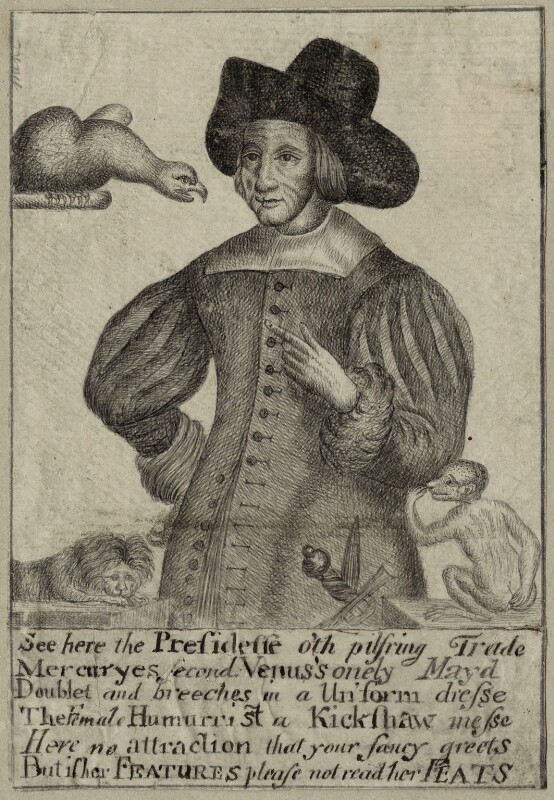
We began with the cross-dressing thief and performer Moll Cutpurse, who sums up early modern England’s contradictory approach to gender and its performance. Both celebrated and censured, Moll is most famous for playing their lute and singing at the Fortune Theatre in 1611. While the epitaph on Moll’s grave genders them female, the poem also speculates that the ashes and dust inside would ‘perplex a Sadducee / Whether it rise a He or She / Or two in one, a single pair’. Much like Joan of Arc, Moll’s identity remains mutable even after their death, offering us space to consider early modern experiences of the non-binary.
Moll Cutpurse, or Mary Frith. Line engraving, printed after 1662. National Portrait Gallery, London. Creative Commons License 4.0.
Rope-dancers often performed in the playhouses owned by the shareholders of the acting companies, including the Swan, the Hope, and the Red Bull. A surviving handbill from Bristol in the 1630s describes how ‘one Mayd of fifteene years of age, and another Girl of foure years of age doe dance on the lowe Rope’ and ‘turne on the Stage’. (Our thanks to Clare McManus for her brilliant work on this exciting area of early modern performance, which you can read more about in some of the suggested further reading below!) The youth and gender of these performers is important: just as young boys were recruited and apprenticed to the playing companies, children of all genders worked and performed across the country.
A Scottish “gentlewoman minstrel” was paid 2s in 1603 for performing in Carlisle. Both her gender and nationality distinguish her from the payments made to other musicians, but in every other respect, it seems they were paid the same. The description of “gentlewoman” is interesting: women who performed in public were often conflated with sex workers or deemed sexually available, so perhaps this label attempted to safeguard the reputations of both her and the event at which she performed. A blind harper was paid 12d in 1602 for a civic performance, also in Carlisle. While his disability is noted in the record of payments, his wages seem on a par with sighted musicians. This suggests that while he was not discriminated against with low pay for his disability, his skill was not considered worth extra renumeration despite his lack of sight.
Sometimes disability itself was the attraction: Adrian Provoe and his wife were granted a four day licence in Norwich in 1632 for her to ‘show diverse works &c done with her feet’. Provoe’s wife is not named, and is only mentioned in connection to her husband. Their relationship may have been a true and supportive partnership, or an exploitative and abusive one, or anywhere in between. The power differences between husbands and wives, the able-bodied and the disabled, are not preserved in the record.
Our discussion then moved on to how we might include evidence such as this, and the questions they raise, in the work the Globe does with schools and the public. This was a brave and honest discussion as we moved away from the historical detail to more challenging subjects such as how to broach the racism, sexism, homophobia, and transphobia of the period, while acknowledging these issues are still very present in our society.
Everyone participating in these sessions was asked to complete a very short survey at the beginning and end, consisting of just two questions. We were keen to learn how much knowledge and confidence participants had in discussing these issues before we ran the sessions, and if this changed because of the training. The responses were overwhelmingly positive – everyone’s knowledge about these issues, and their confidence in broaching them with the public and education groups they worked with had risen. Some participants commented they appreciated the range of inclusive language that had been offered during the session, giving them new tools and strategies to discuss these important historical moments with their students or tour groups.
The evidence of diverse performers and performance across early modern England is already before us: we just need to look for it.
Further reading
Printed resources
Astington, John, ‘Trade, Taverns, and Touring Players in Seventeenth-Century Bristol’, Theatre Notebook, 71.3 (2017), 161–68
Brown, Pamela Allen, ‘Why Did the English Stage Take Boys for Actresses?’, Shakespeare Survey, 70 (2017), 182–87
Brown, Pamela Allen, and Peter Parolin, eds., Women Players in England 1500 – 1660 (Aldershot, Hampshire: Ashgate Publishing, 2005)
Clare, Eli, Exile & Pride: Disability, Queerness, & Liberation 2nd edn (Cambridge, MA: South End Press, 2009)
Faye, Shon, The Transgender Issue: An Argument for Justice (London: Penguin, 2021)
Halberstam, Jack, Trans*: A Quick and Quirky Account of Gender Variability (Berkeley: University of California Press, 2018)
Heyam, Kit, Before We Were Trans: A New History of Gender (London: Hachette, 2022)
Korda, Natasha, Labors Lost: Women’s Work and the Early Modern English Stage (Philadelphia: University of Pennsylvania Press, 2011)
Loftis, Sonya Freeman, Shakespeare and Disability Studies (Oxford: Oxford University Press, 2021)
Love, Genevieve, Early Modern Theatre and the Figure of Disability (London: Arden Bloomsbury, 2018)
McManus, Clare, “Sing it Like Poor Barbary’: Othello and Early Modern Women’s Performance’, Shakespeare Bulletin, 33.1 (2015), 99 – 120
McManus, Clare, ‘The Vere Street Desdemona: Othello and the Theatrical Englishwoman, 1602 – 1660’ in Women Making Shakespeare: Text, Reception and Performance eds. Gordon McMullan, Lena Cowen Orlin, & Virginia Mason Vaughan (London: Arden Bloomsbury, 2014), pp. 221 – 232
Nardizzi, Vin, ‘Disability Figures in Shakespeare’ in The Oxford Handbook of Shakespeare and Embodiment: Gender, Sexuality and Race ed. Valerie Traub (Oxford: Oxford University Press, 2016), pp. 454–467
Non-Binary Lives: An Anthology of Intersecting Identities eds. Jos Twist, Meg-John Barker, Ben Vincent, & Kat Gupta (London: Jessica Kingsley, 2020)
Page, Nick, Lord Minimus: The Extraordinary Life of Britain’s Smallest Man (London: HarperCollins, 2001)
Schaap Williams, Katherine, Unfixable Forms: Disability, Performance, and the Early Modern English Theater (Ithaca, NY: Cornell University Press, 2021)
Siebers, Tobin, ‘Shakespeare Differently Disabled’, in The Oxford Handbook of Shakespeare and Embodiment: Gender, Sexuality, and Race ed. Valerie Traub (Oxford: Oxford University Press, 2016), pp. 434–454
Shakespeare, Tom, ‘The Social Model of Disability’ in ed. Lennard J. Davis, The Disability Studies Reader 5th edn (New York: Routledge, 2017), pp. 195 – 203
Whittlesey, Christy, The Beginners’ Guide to Being a Trans Ally (London: Jessica Kingsley, 2021)
Online resources:
Anderson, Susan, ‘Disability in Shakespeare’s England’, That Shakespeare Life, 2019
This is the first of a mini-series of blogs reflecting on the Diverse Shakespeare at Shakespeare’s Globe programme led by myself and Mel in November 2021, which offered training sessions on the diversity of the early modern period to Globe Education Practitioners and volunteer tour guides at Shakespeare’s Globe. With the guidance of our external consultant Dr Onyeka Nubia (University of Nottingham) and Dr Will Tosh (Head of Research at Shakespeare’s Globe) we devised and ran four sessions over two weeks. The sessions aimed to equip staff with the information and skills to educate the public and educational groups that visit the Globe about the diversity of early English modern society. By working with the Globe’s guides and education practitioners, we aim to disseminate our materials with a large audience over a long period of time.
We divided the training workshops into two specific sessions. One session considered the diverse gendered and disabled bodies of early modern performers in the period, while the other session focused on early modern ideas of racemaking (i.e. the creation of ideas of race, ethnicity, and identity), evidence of performers of colour in the period, and how these tropes are embedded in or resisted by popular culture today. Each session was designed to support the organisation’s ‘one Globe’ approach to their anti-racist commitments, which seeks to empower all colleagues to inform the communities visiting the Globe, to counter any misinformation about the period and so to disseminate an inclusive understanding of the diversity present within the Shakespearean period.
In addition to equipping participants with the intersectional knowledge to contextualise early modern performance cultures, the sessions also provided a ‘toolbox’ to support attendees to reappraise the Shakespearean texts that we think we know inside out. We asked participants to rethink how markers of difference were achieved in early modern performance – such as how Black or disabled characters were depicted on the Shakespearean stage – while exploring the pervasive ways in which systems of oppression are so deeply embedded in material from the period that they might be rendered invisible. Drawing on rich fields of scholarship, the sessions dedicated time to identify specific terminology that signposts misogynistic, ableist, and racist attitudes, exploring how these references might be connected to wider networks of early modern culture. There’s nothing harder for an academic than answering a seemingly simple question from a member of the public: these questions send us back to first principles and push us to think and communicate more clearly than any other. Because of this, the training sessions aimed to support Globe staff answer these kinds of open, general questions from the enthusiastic publics who visit their building or take their classes and who are seeking to understand the Shakespearean period more deeply. Some of these overarching questions included:
• Did women perform in early modern England? • Were there performers of colour on the early modern stage? • What value is there in producing/performing/studying texts that include problematic content? • What methods best allow us to negotiate this content in a meaningful way without repeating the violence of the past? • Was Shakespeare racist?
We found these questions, some intentionally provocative, very useful to draw out conversation, find nuance and demonstrate how complex lived experiences can be rendered (in)visible on both page and stage. While these conversations might be difficult or uncomfortable, they encourage people to reflect not only on their own relationship with these well-known plays but also their position in the present world. We intended to create a safe space for volunteers and education practitioners to build the confidence to contribute and lead these discussions at the Globe. However, in building and running the sessions, we encountered a similar sense of self-reflection. While preparing the sessions, we found questions arising about curation. Providing an overview of any marginalised community in history can be daunting and challenging, with limited time to discuss extant archival records, textual clues, and visual material such as artwork or emblems. While these sources contribute to a rich tapestry of lived experiences and communities, almost inevitably, we would never be able to talk about every account or voice. Building the sessions, we spent time thinking about what materials we include and exclude, as well as how these curatorial decisions might impact the shape of the sessions and thus, the breadth of diversity presented to attendees. How do we ensure we do justice to the lives often rendered invisible through hostile archival practises? How do we recover the humanity that historically has been diminished or queried?
This three-part series will respond to these questions, as we rethink diversity in Shakespeare and beyond. In the following two entries, Mel and I will each detail the content of our respective sessions. This includes the archival evidence demonstrating female, trans, non-binary and gender non-conforming performers across a range of cultures of performance in England; how the popular early modern maxim ‘to wash an Ethiop’ has permeated and resurfaced in present-day popular culture; critically appraising a taxonomy of terms that might refer to diverse, and often marginalised identities in the early modern period. In doing so, the series will act as an experiential reflection to consider how notions of diversity operate in Shakespeare and his contemporaries, and how we receive or respond to these representations today.
The Diverse Shakespeare at Shakespeare’s Globe project was made possible by funding from the Southlands Methodist Trust (SMT). This public engagement project called on the research findings of Engendering the Stage, funded by the Leverhulme Trust. Special thanks must go to Dr Onyeka Nubia at the University of Nottingham and Dr Will Tosh at Shakespeare’s Globe for supporting this project and so generously sharing their time and expertise. Thank you to Shakespeare’s Globe staff and volunteers, whose kind welcome and thoughtful participation made for excellent discussions. We look forward to sharing more about the work from this project on this blog in the coming weeks!