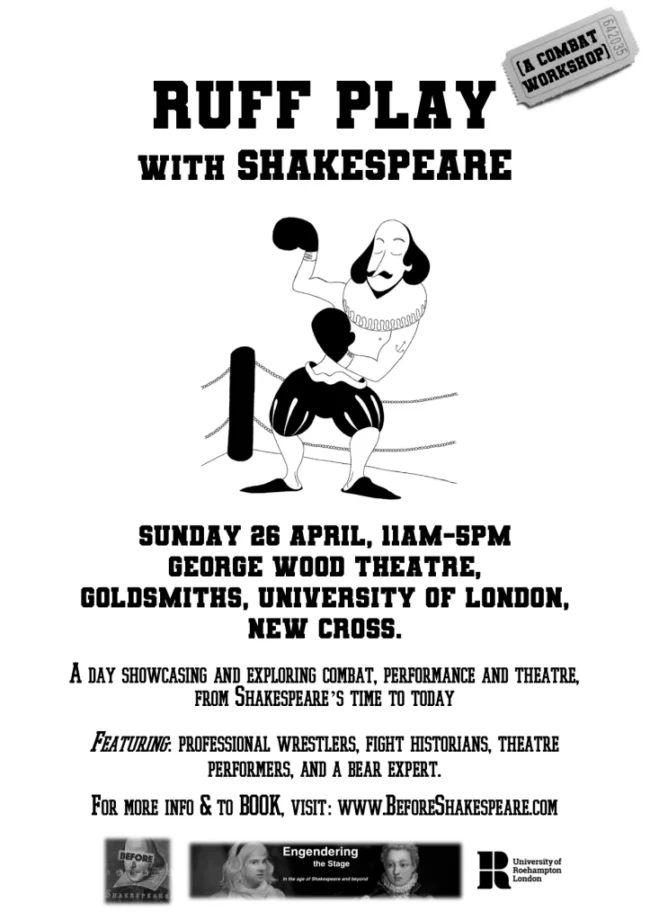
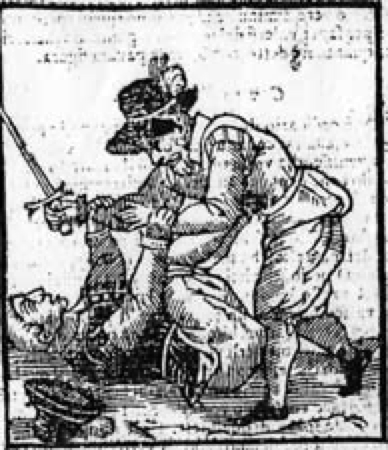
Before Shakespeare and Engendering the Stage are delighted to announce our next performance workshop, focusing on combat as entertainment—in both Shakespeare’s time and today. Combat, acrobatics and feats of strength were everywhere in the early modern period: wrestling happened on the streets, in the countryside and in plays such as As You Like It, and the most famous male Tudor, Henry VIII, was also a renowned wrestler. Women and men performed strength, sword and rope displays for public audiences. Animal combat was probably an even more popular cultural pursuit than theatre and was watched by all sectors of society across the country and in specially-designed venues in London that were in direct competition with the playhouses. Although modern culture tends to sharply distinguish between theatre and combat as forms of entertainment, the playhouses of Shakespeare’s time were dedicated spaces for play and games of all kinds, and were as much fencing venues as theatres. Likewise, up until the twentieth century music halls and theatres also hosted boxing and wrestling matches, and employed boxers and wrestlers for sparring exhibitions or as actors in plays.

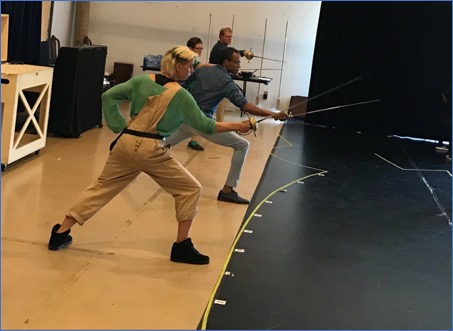
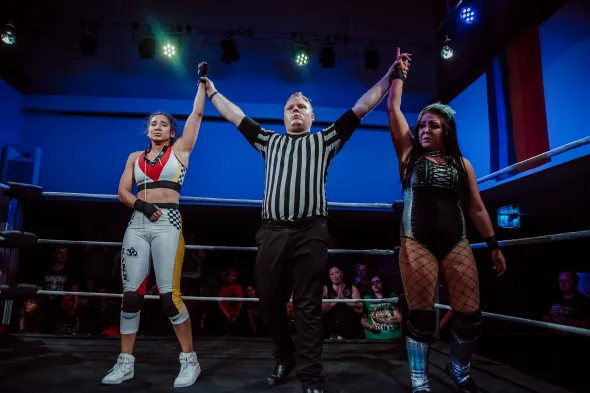
These historical matters have parallels with the contemporary UK wrestling scene. The history of theatre is one of deliberately broken traditions because the London playhouses were closed down in 1642, and boxing and wrestling venues have similarly been controversial spaces subject to control and suppression. In the late-nineteenth century legal changes sent some form of public combat underground, men’s wrestling was banned in London in the 1930s, women’s wrestling in London in the ’50s, ’60s and ’70s, and the decision to stop broadcasting wrestling on television in 1985 drastically affected its audience and popularity. But now the UK wrestling scene is so thriving and exciting that a current research project is actually called Wrestling Resurgence. Just as the work of our two projects has stressed the role of women and marginalised people in early modern performance, including combat and strength displays, so contemporary wrestling is thinking anew about gender, sexuality, race and disability in the ring and in its audiences.
Our hope is to use this event to bring these various ideas together, with a focus on using practice and performance as much as conversation to tease them out. Though we’ve swapped staff, methods, ideas and findings before, this will be the first time that Engendering the Stage and Before Shakespeare are in a room together testing out our ideas in performance. We will bring together combat and theatre historians, fight directors, professional wrestlers, sports scholars and animal archaeologist for a conversation in which no one person is an expert, and look forward to generating new conversations and discoveries between our speakers and our audience. For anyone interested in street performance, popular play, combat as a form of entertainment or the links between theatre, circus and sport, we’d be excited to have you join us.
For more information, see the Before Shakespeare “Ruff Play with Shakespeare”