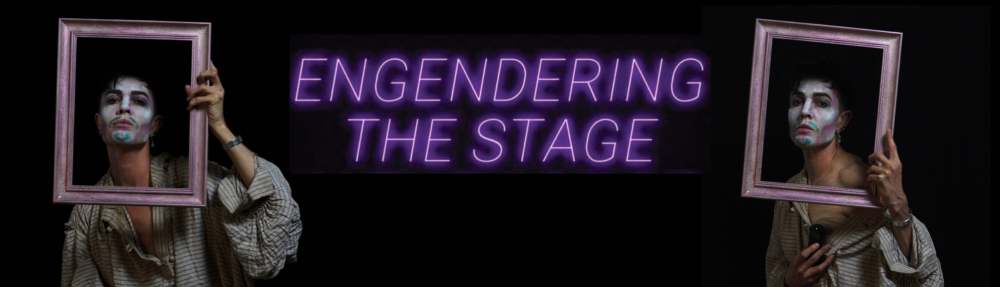
OCTOBER, 2025. Engendering the Stage in the Age of Shakespeare and Beyond. Edited by Peter Cockett and Melinda Gough (Toronto: University of Toronto Press, 2025).
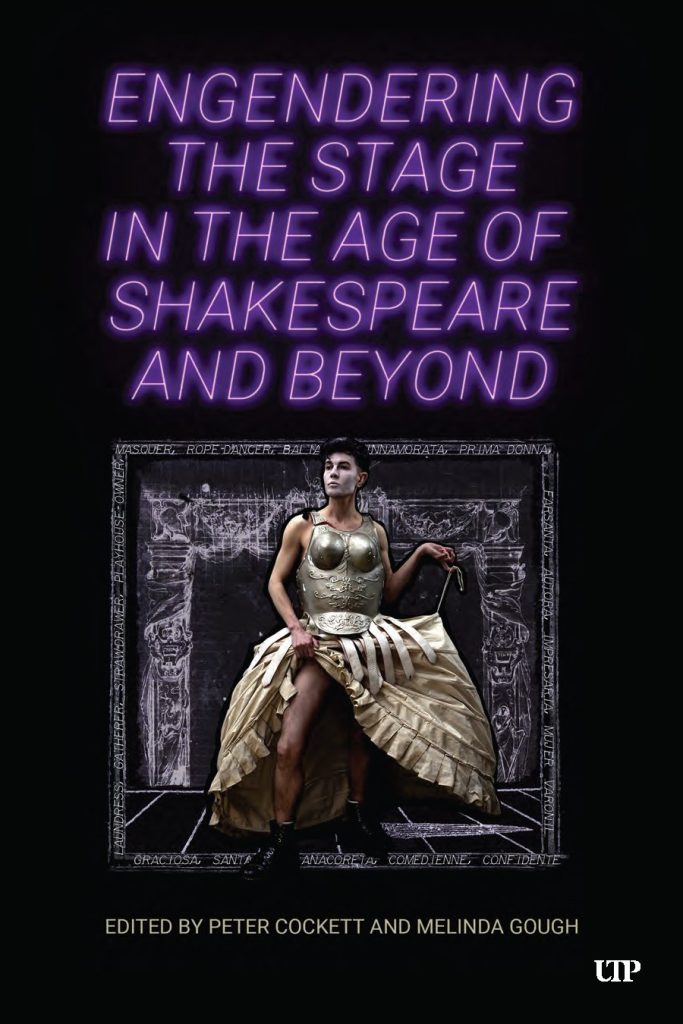
Engendering the Stage in the Age of Shakespeare and Beyond steps beyond the myth of the all-male stage, centring feminist, queer, and trans scholars and artists to reveal the deeper complexities of gendered performance on stage today and within the records of theatre history.
Engendering the Stage in the Age of Shakespeare and Beyond centres dialogue between scholars, students, and professional theatre practitioners to rethink gender on the early modern stage and its resonance for casting, staging, and design in contemporary classical theatre. Its scope extends beyond the confines of Shakespeare’s Globe and the myth of the all-male stage to explore the exciting possibilities of gendered performance evident on the stages of Europe and in the work of less-famous playwrights.
Women and queer and trans artists and artisans were central to the theatres of early modern Europe, and this book’s collaborative exploration of this historical evidence opens exciting new avenues for theatrical production and research. It mobilizes shared insights by scholars and theatre practitioners who hold deep investments in gender equity in their respective workplaces and explores Two-Spirit and trans histories typically excluded in both theatre history studies and present-day performance repertoires.
Engendering the Stage in the Age of Shakespeare and Beyond offers provocations arising from a five-day Performance as Research (PaR) workshop at the Stratford Festival. Featuring guest artist and actor commentary, a poem, a zine, scholarly essays and reflections, and three specially commissioned visual art pieces, the book adapts to print form the open and exploratory spirit of the workshop itself, inviting readers to embrace the possibilities of trans-disciplinary, provisional knowledges and knowledge dissemination that are central to PaR methodologies.
Buy the book from University of Toronto Press, or recommend to your library!
| “This book is an energizing and pathbreaking collection in so many ways. It’s an incredibly generous, open example of how to combine cutting-edge scholarship in early modern studies with ethical practice: how to be reflective and reflexive in trans-inclusive work, how to set a collection of essays in genuine conversation with one another, and how to do decolonial early modern scholarship that isn’t just ‘writing about racism.’ I’m so enthused by having read it, and I know scholars and students alike will be too – it’s an essential addition to any classroom working with early modern texts or with dramatic texts more broadly.” Kit Heyam, Award-Nominated Writer, Historian, Heritage Practitioner, and Educator |
MAY, 2025. THE LIEUTENANT NUN: Annotated Translation of the Play, Historical Accounts and Documents about Antonio/Catalina de Erauso. Translated and edited byMarta Albalá Pelegrín and Edward McLean Test
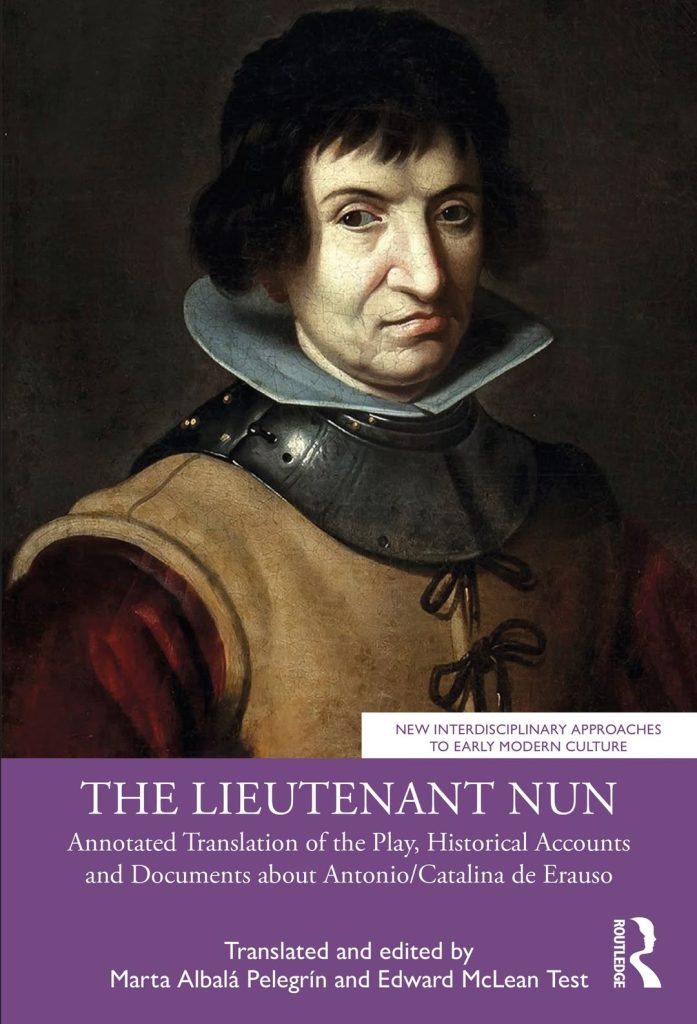
This volume contains the English translation of the seventeenth-century literary and archival materials about a Basque person who died under the name Antonio de Erauso (b. ~1580, d. 1650), bringing readers closer to an individual who could be considered a trans ancestor.
Born into a noble family in San Sebastian, Spain, as Catalina de Erauso, Erauso lived most of their life as a man, serving as a soldier in Peru and Chile, and working as a muleteer in Mexico until their death in 1650. This book provides – for the first time – an English translation of texts related to Erauso: the contemporary play Famosa comedia de la monja alférez (The Famous Play of the Lieutenant Nun), contemporary Accounts (Relaciones) about Erauso, selected archival documents about Erauso’s Petition for a Pension to the Council of the Indies, and contemporary letters mentioning Erauso.
This book presents early modern scholars working in English with new material essential to understanding the historical and literary figure of Erauso, and historical documentation that provides a glimpse into the terms Erauso (and others) seemingly chose for themselves.
Edward MacLean (Mac) Test was a central participant in the Engendering the Stage workshop at the Stratford Lab where he worked with actors and guest artists on a scene from the play. He was in the early stages of translating the play at that point and it is a real delight to see this fantastic addition reach print today.
Buy the book from Routledge, or recommend to your library!
2022. Clare McManus and Lucy Munro’s article, ‘Engendering the Stage: Women and Dramatic Culture’, is now published in Michelle Dowd and Tom Rutter’s new book: The Arden Handbook of Shakespeare and Early Modern Drama: Perspectives on Culture, Performance and Identity (London: Bloomsbury Arden Shakespeare, 2022), pp. 120-30.
“This chapter focuses on the contribution of women, girls and gender non-conforming individuals to the performance and theatrical cultures of early modern England. We draw on the productive unsettling of binary categories of ‘man’ and ‘woman’ by feminist, queer and trans theorists to include people who might today identify as trans, non-binary, gender-queer or gender-fluid, to use a few of the terms available to us now and which – if available – might have been used by some early moderns who are referred to and indeed refer to themselves as women or men. Where once scholars such as E. K. Chambers and G. E. Bentley examined an ‘all-male stage’ rather bluntly defined as populated by adult men and boy players, the work of queer and trans studies continues to show that these professional categories contain no end of fluidity, malleability and variety in the bodies, genders and sexualities of those labouring on and for those stages (see Chess 2019; Barker and Munro forthcoming; Higginbotham and Johnston 2018). Using a capacious definition of dramatic culture rather than narrower concepts of theatre, drama or acting, we revisit four important areas explored by previous scholarship – performance, theatrical labour, spectatorship and dramatic creation – and reconsider the archival evidence in order to challenge central concepts such as actor, player, owner, builder, author and, indeed, the play” (181).
Buy the book from Bloomsbury Press, or recommend to your library!
APRIL 2019. Elizabeth Cruz-Petersen’s article, “Swordplay Uncloaked: Women as Active Agents in Ana Caro’s Valor, agravio, y mujer and Lope de Vega’s La pobreza estimada,” is now out in Comedia Performance 16 (2019): pp.86-102.
ABSTRACT: This article explores possible dance and swordplay choreography in Felix Lope de Vega’s La pobreza estimada (1597-1603) and Ana Caro’s Valor, agravio, y mujer (1630s-1640s) in hopes of shedding light on the manner in which women as active agents or bodies in transaction contributed to the sociopolitical discourse of the space in theater. The excerpts and images examined from treatises on acting, dance, and swordsmanship, such as Alonso López Pinciano’s Philosophía antigua poética (1596), Juan de Esquivel Navarro’s Discursos sobre el arte del danzado (1642), and Luis Pacheco de Narváez’s Libro de las grandezas de la espada (1600), help the reader envision women wielding swords in early modern Spanish theater.
MARCH 2019. Melinda Gough’s book, Dancing Queen, is now out with University of Toronto Press!
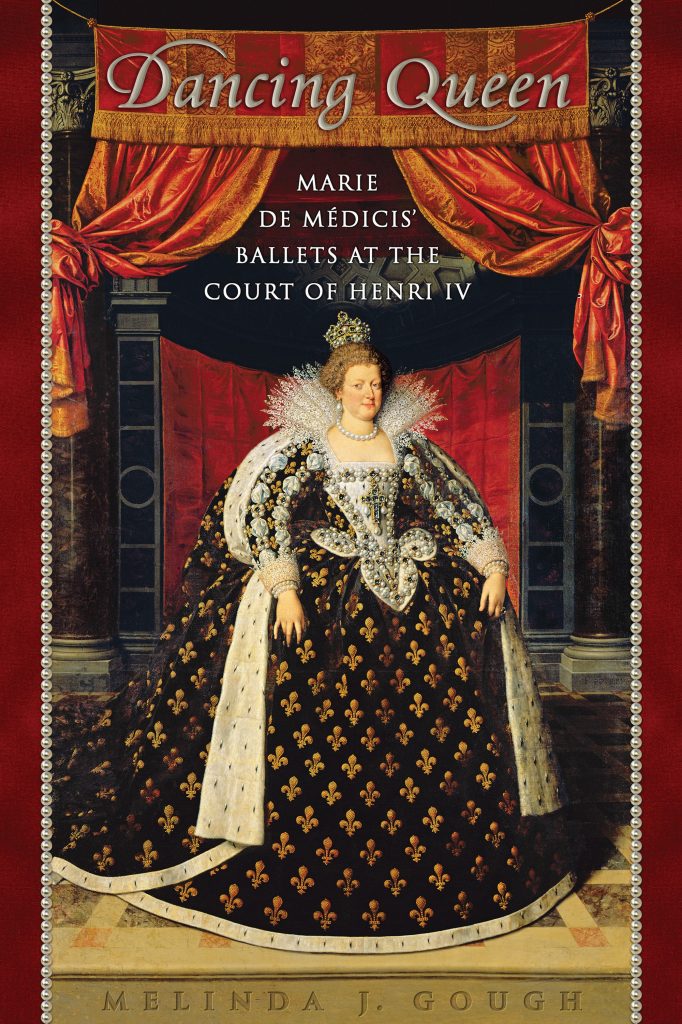
Under glittering lights in the Louvre palace, the French court ballets danced by Queen Marie de Médicis prior to Henri IV’s assassination in 1610 attracted thousands of spectators ranging from pickpockets to ambassadors from across Europe. Drawing on newly discovered primary sources as well as theories and methodologies derived from literary studies, political history, musicology, dance studies, and women’s and gender studies, Dancing Queen traces how Marie’s ballets authorized her incipient political authority through innovative verbal and visual imagery, avant-garde musical developments, and ceremonial arrangements of objects and bodies in space. Making use of women’s “semi-official” status as political agents, Marie’s ballets also manipulated the subtle social and cultural codes of international courtly society in order to more deftly navigate rivalries and alliances both at home and abroad. At times the queen’s productions could challenge Henri IV’s immediate interests, contesting the influence enjoyed by his mistresses or giving space to implied critiques of official foreign policy, for example. Such defenses of Marie’s own position, though, took shape as part of a larger governmental program designed to promote the French consort queen’s political authority not in its own right but as a means of maintaining power for the new Bourbon monarchy in the event of Henri IV’s untimely death. Click HERE to find out more and purchase.
| “Dancing Queen is a meticulous, richly textured work of scholarship that makes an important contribution to understandings of early modern queenship and court culture as well as to the history of court ballet. Melinda J. Gough’s discovery and attentive synthesis of previously unknown archival documents are truly meaningful and revise the standard histories of French court ballet.” Ellen R. Welch, Department of Romance Studies, The University of North Carolina at Chapel Hill |